Wolf’s Neck
Ronja, the Robber's DaughterWolf’s Neck is the narrow pass below Matt’s Fort: a guarded approach, a seasonal obstacle, and the recurring boundary at which Ronia and Birk part and promise to meet again. Its role shifts from seeming to guarantee the robbers’ safety to framing the limits of that safety, while its position between the fort and forest makes it a practical and emotional threshold in the story.
Setting and Strategic Role
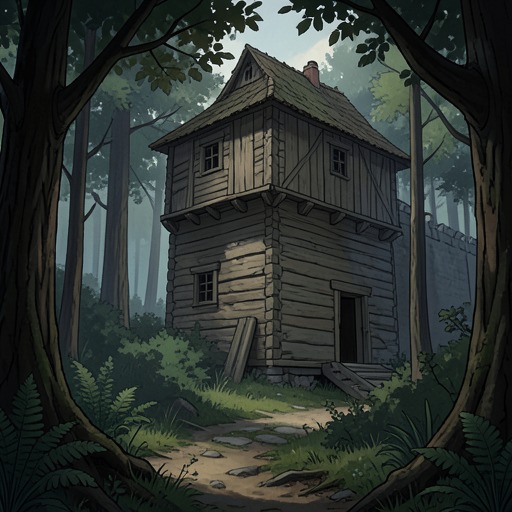
Matt’s Fort stands high on a cliff, sheer-sided on three sides; the only ordinary approach is a narrow bridle path that zigzags down the mountain and disappears into the forest. The pass is the approach’s choke point. The robbers boast that its position makes the fort inaccessible and laugh at the thought that anyone might try to climb the cliffs. Their confidence has a blind spot: they do not know where Ronia goes to practice being unafraid.
Matt describes Wolf’s Neck as the place where an advancing force can be stopped. The defenders could roll rocks down on anyone coming up the bridle path, and he hints that they have other means as well. Noddle-Pete echoes the threat, recalling that he once caught many wolves there, though age has left him joking that he can now catch only his own fleas. The pass is thus both a real defensive position and a stage for the robbers’ bravado.
That confidence is tested when Borka’s robbers gain a foothold in the North Fort without being seen. Matt’s men keep watch at Wolf’s Neck day and night, since anyone approaching on foot or horseback is supposed to pass through it, yet no guard spots the newcomers. The breach unsettles Matt not only because rivals have entered the fort, but because the supposedly watched route has failed to explain their arrival. Wolf’s Neck is a formidable threshold, but guarding it does not make the fort invulnerable.
A Boundary in the Forest
Beyond its military importance, Wolf’s Neck lies within a living woodland that cannot be reduced to the robbers’ territory. Ronia and Birk argue over her claim to fox cubs and to the woods. Birk answers that the cubs belong to themselves and that the forest belongs to the foxes, wolves, bears, elk, wild horses, birds, and even its smaller creatures; he includes harpies, gray dwarfs, rumphobs, and murktrolls among its inhabitants. The pass’s connection between the fort and the forest therefore opens onto a world shared by many forms of life, not simply a landscape to be claimed or controlled.
The woodland’s seasonal life is especially vivid in spring. After the long winter, snow streams down the cliff faces toward the river, and the river roars and foams. A turbulent stream rushes down Wolf’s Neck, splashing around the horses’ hooves as Matt and his robbers ride through the narrow pass one morning. Their return to the road and to their customary life is marked by singing and whistling; for Ronia, the same thaw means that the woods she has missed are opening to her again.
At a nearby glade, the children sit without disturbing the animals around them: blackbirds and cuckoos call, fox cubs play by their den, squirrels run through the trees, hares vanish into the bushes, and a pregnant snake rests in the sun. Ronia accepts Birk’s point that she should not take a horse away from the woods where it belongs, even though she still wants to ride. The forest is for everyone. That recognition gives the route through Wolf’s Neck a larger significance: it connects a fortified human home to a shared wilderness whose inhabitants resist being treated as property.
Crossings, Separation, and Return
In winter, Wolf’s Neck becomes a point where reunion has to yield to separation. After Ronia and Birk travel through swirling snow, she repeatedly checks that he is still following, only a rope’s length behind her. Near the pass they must part: Ronia continues toward home, while Birk takes a secret way back to Borka’s Keep. They stand in the falling snow, struggling to say goodbye, and Ronia tells him she wishes he were her brother. The pass makes the division between their homes concrete, but the distance between them does not undo the bond they are beginning to name.
The same winter geography later defines the danger of living apart. Ronia warns that if conditions return to what they were, she may be unable to ski down even as far as Wolf’s Neck; with Birk living in Bear’s Cave, he could die there. Birk replies that it is summer now, but Ronia answers that the season does not settle whether she will return to Matt’s Fort. The pass is not merely a line on a route: under snow, it can become an impassable limit on aid and movement, sharpening the consequences of their chosen separation.
When Ronia and Birk later walk through the forest with Matt, Wolf’s Neck again becomes the place where their routes diverge. Matt is already ahead, singing, and the others hurry after him. At the pass, Birk stops and says he wants first to go to Borka’s Keep to see Undis and Borka. He thanks Matt for allowing him to visit Matt’s Fort and Ronia whenever he likes; Matt agrees, although he admits that this will not be easy for him. Their exchange turns the old dividing line into a negotiated passage between households.
Birk and Ronia take hands at the place where they have always said goodbye. He promises that he will see her every day and addresses her as his sister; she answers that she will see him every day too. The repeated farewell is changed, not erased: Wolf’s Neck remains where they part, but the parting no longer has to mean estrangement or uncertainty about whether they will meet again.
Gathering Place and Narrative Significance
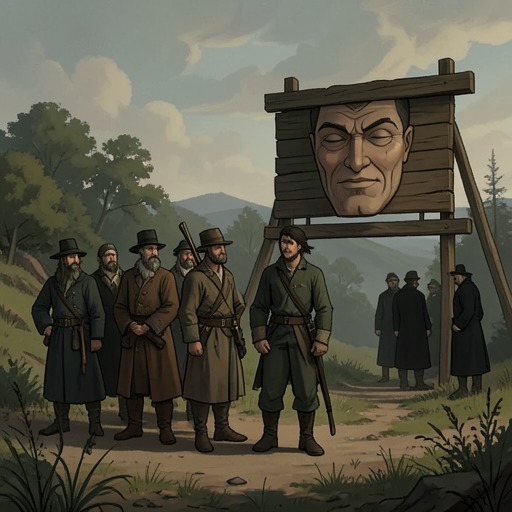
The pass also becomes a public gathering point for the robbers. After Noddle-Pete proposes a single combat to settle who should lead a united band, Matt and Borka agree to the contest. On a cold, sunny morning, with frost on the ground, both bands assemble in the open space below Wolf’s Neck and form a ring around the two men. Noddle-Pete watches from a nearby rocky outcrop, wrapped in fur, as the champions prepare to fight. A route once described chiefly as a means of keeping outsiders out becomes the setting for a decision about how the rival bands might be joined.
Across these episodes, Wolf’s Neck holds together several scales of conflict and attachment. The robbers treat it as a defensive barrier, but the unseen entry into the North Fort exposes the limits of that assurance. Its seasonal stream and winter snow make the landscape an active condition of travel rather than a fixed backdrop. And at the same boundary, Ronia and Birk repeatedly move from separation toward a chosen, continuing relationship. The pass is therefore both a bottleneck in the robbers’ world and a threshold through which that world’s divisions can be crossed.